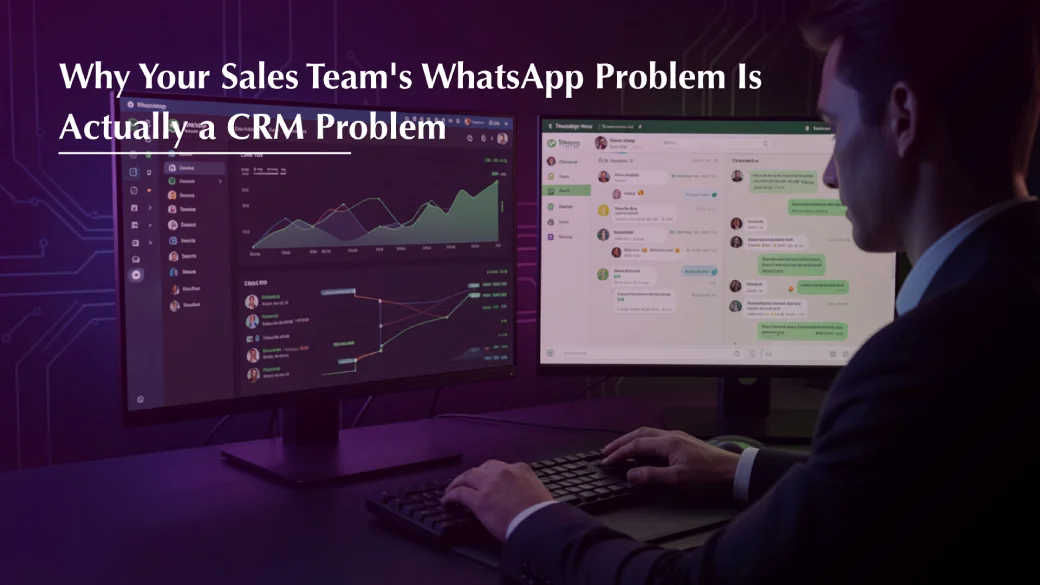
Why Your Sales Team's WhatsApp Problem Is Actually a CRM Problem
Walk into the sales office of almost any real estate developer in India today.
Look at the phones of the sales executives.
You will find customer conversations happening over WhatsApp. Lead details being shared in group chats. Site visit confirmations being sent through personal messaging apps. Payment reminders being followed up informally.
Most sales leaders see this as a discipline problem.
It is not.
It is a CRM problem.
Why Sales Teams Abandon CRM for WhatsApp
Sales executives do not move to WhatsApp because they prefer chaos.
They move there because it is faster, simpler, and requires less effort than the CRM.
When a CRM requires them to fill ten fields before logging a follow-up, they skip it.
When a CRM makes them wait for page loads, they stop using it.
When the CRM does not reflect customer information the way they actually work, they find workarounds.
WhatsApp wins not because it is a better business tool. It wins because it creates zero friction.
And in a high-pressure sales environment, friction is the enemy of adoption.
The Business Risk of WhatsApp-Led Sales Operations
The consequences of customer data living in personal WhatsApp accounts are severe:
When a sales executive leaves, they take the customer relationship with them. The developer has no visibility into the conversation history. The lead is effectively lost.
Data becomes impossible to analyze. You have no visibility into what was promised, discussed, or negotiated. Disputes arise. Conversions are misattributed.
Leadership cannot forecast accurately. If pipeline data is incomplete because conversations are happening off-system, projections are based on partial reality
This is not just an operational risk. It is a strategic one.

The Right Solution Is Not Discipline. It Is Design.
The answer is not stricter enforcement. It is a better design.
A well-designed Salesforce implementation reduces friction so dramatically that the CRM becomes the path of least resistance.
One-click call logging. Automatic lead assignment. Mobile-first access. WhatsApp integration that captures conversations directly into the customer timeline. Voice-to-text activity capture.
When Salesforce is built around how sales executives actually work, rather than how a generic workflow expects them to work, adoption follows naturally.
The system becomes an assistant, not an auditor.
The Leadership Opportunity
Leaders who solve the WhatsApp problem through CRM design, rather than through policing, create a different kind of culture.
A culture where data is trusted. Where pipeline accuracy is high. Where sales managers coach using data, not gut feel.
And where the business grows not because individuals are working harder, but because the system is working smarter.