Beyond Automation: Building an Intelligent Real Estate Enterprise on Salesforce - Part 5
For years, real estate developers have treated CRM as a digital ledger - a place to log leads, record calls, and track bookings.
But in today's market, that mindset is outdated.
Automation is no longer differentiation. It is survival.
The modern real estate enterprise must evolve from process automation to revenue intelligence. And that shift begins with how platforms like Salesforce are architected.
Most implementations stop at workflows:
- Lead assignment rules
- Follow-up reminders
- Booking status dashboards
- Inventory reports
These are necessary - but they do not create advantage.
Advantage is created when your Salesforce ecosystem begins to think.
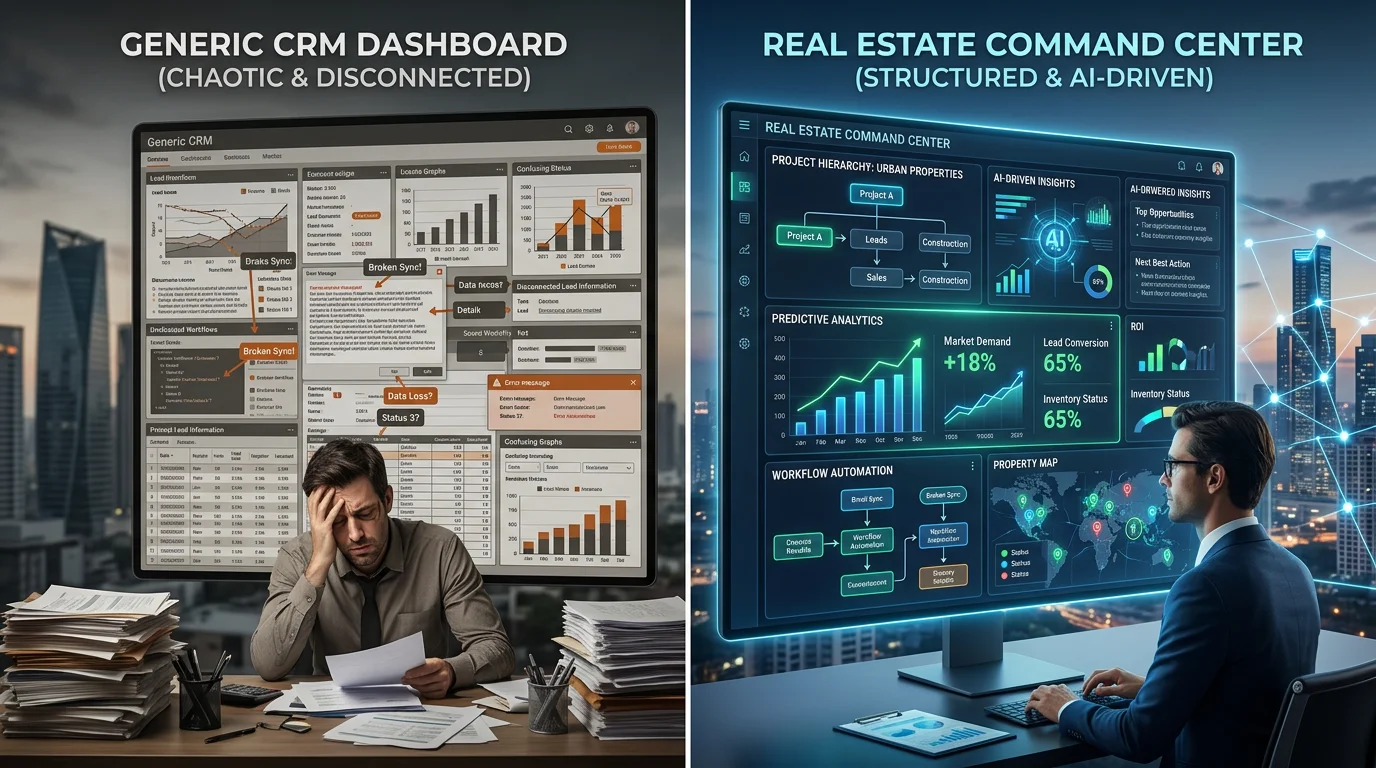
From Workflow Engine to Intelligence Engine
A domain-led Salesforce architecture transforms CRM into a real-time decision layer across the organization.
Instead of merely tracking inquiries, the system answers critical business questions:
- Which leads have the highest booking probability today?
- Which channel partners are likely to convert in the next 30 days?
- Which inventory typology is slowing down and needs pricing correction?
- Which campaign is driving site visits but not bookings — and why?
This is where intelligence compounds.
By integrating marketing signals, call data, behavioral analytics, and inventory performance into one unified model, Salesforce stops being a backend tool and becomes the enterprise control tower.
With AI-driven lead scoring, follow-ups are no longer uniform - they are prioritized. High-intent buyers receive instant, personalized engagement. Low-intent leads enter automated nurturing journeys.
Sales teams don't just work harder. They work sharper.
Intelligence Across the Real Estate Lifecycle
Real estate is not a single transaction business. It is a multi-stage lifecycle:
Inquiry → Qualification → Site Visit → Negotiation → Booking → Documentation → Possession → Relationship
Every stage generates data. Most organizations fail because this data remains fragmented.
An intelligently architected Salesforce ecosystem connects every touchpoint:
- Pre-sales call sentiment analysis informs sales strategy
- Site visit behavior influences inventory recommendations
- Payment patterns trigger proactive engagement
- Post-sales escalations feed back into pre-sales messaging
When these loops are connected, your organization becomes self-learning.
Over time, patterns emerge:
- Which micro-markets convert faster
- Which customer personas delay decisions
- Which sales managers outperform in specific ticket sizes
- Which projects require stronger digital nurture flows
This is no longer CRM management. This is revenue science.
The AI Multiplier
When AI layers are integrated on top of Salesforce - conversational bots, predictive analytics, marketing data clouds - the system evolves further.
Imagine:
- AI automatically reassigning dormant leads to fresh closers
- Predictive models recommending pricing adjustments
- Campaign budgets dynamically optimized based on booking velocity
- Sales forecasts updating in real time based on inquiry momentum
This is not futuristic. The infrastructure already exists.
The difference lies in architecture.
Generic implementations build processes.
Domain-led implementations build intelligence frameworks.
The Strategic Outcome
When Salesforce becomes an intelligence engine:
- Conversion ratios improve without increasing ad spend
- Sales cycles shorten due to prioritized engagement
- Forecasting becomes more accurate
- Channel partner efficiency increases
- Leadership decisions become data-backed, not intuition-led
In volatile markets — especially in India's fast-evolving real estate landscape — speed and intelligence are more powerful than scale.
Inventory depreciates.
Intelligence appreciates.
The developers who will dominate the next decade are not necessarily the ones launching the most projects.
They are the ones building intelligent revenue ecosystems.
Automation was Phase One.
Integration was Phase Two.
Intelligence is Phase Three.
And Salesforce, when architected through a real estate lens, becomes the backbone of that transformation.