The Data Problem in Real Estate: Why Most Salesforce Implementations Fail to Deliver Insights - Part 7
Over the last decade, real estate developers across India have invested heavily in CRM platforms like Salesforce. The promise was compelling: centralized customer data, better lead tracking, improved sales efficiency, and data-driven decision making.
Yet, despite these investments, most leadership teams still struggle with a basic question:
“Why don’t we have meaningful insights from our CRM?”
The problem rarely lies with the platform itself. Salesforce remains one of the most powerful enterprise systems in the world. The real problem lies in how the data architecture is designed - or more accurately, how it isn’t.
Most implementations treat Salesforce as a transaction recording system, not as a data intelligence platform.
And that distinction changes everything.
The Fragmented Data Landscape of Real Estate
Real estate organizations generate enormous volumes of data across the lifecycle of a project:
- Digital marketing campaigns
- Lead sources and performance
- Call center interactions
- Site visit conversions
- Channel partner performance
- Sales bookings
- Customer payment journeys
- Construction milestones
- Possession timelines
- Customer service interactions
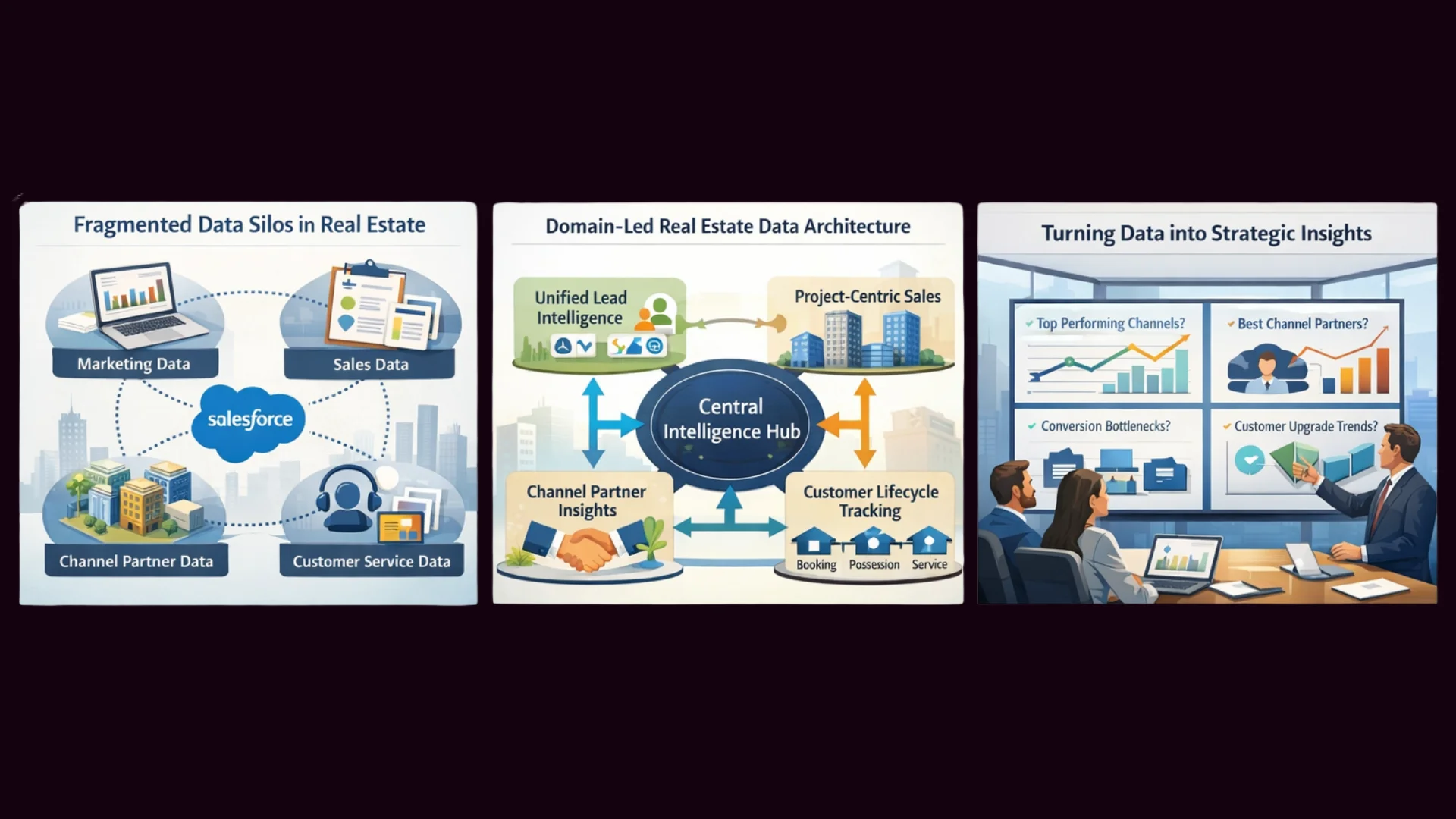
However, in most implementations, this data exists in isolated silos.
Marketing data lives in one dashboard.
Sales data in another.
Channel partner data somewhere else.
Customer service in a completely different system.
The result?
Executives lack a single source of truth.
Why Generalist Implementations Create Data Chaos
Generalist Salesforce partners typically approach implementation from a generic CRM template mindset.
They focus on configuring objects, fields, and workflows, but rarely design the data relationships required for real estate operations.
Critical questions are overlooked:
- How should lead source attribution flow from Meta or Google campaigns into Salesforce?
- How should site visits be tracked across multiple projects?
- How should channel partner sourcing be attributed across deals?
- How should customer lifecycle data connect from booking to possession?
Without these domain-specific data models, the system becomes operationally functional but analytically weak.
Sales teams may log activities.
But leadership still lacks real business intelligence.
What a Domain-Led Data Architecture Looks Like
A real estate-focused Salesforce architecture approaches the problem differently.
Instead of building a CRM first and insights later, it designs the data layer upfront.
Key elements include:
Unified Lead Intelligence
Every lead source — digital campaigns, walk-ins, channel partners, referrals — is mapped into a unified lead intelligence model.
Project-Centric Sales Architecture
Unlike typical industries, real estate sales revolve around projects, towers, units, and inventory availability.
This hierarchy must be embedded deeply into the CRM architecture.
Channel Partner Intelligence
Channel partners drive a massive share of real estate sales.
Yet most CRM systems fail to capture detailed partner performance insights.
A domain-led architecture creates full partner lifecycle visibility.
Customer Lifecycle Intelligence
From booking to possession to post-possession service, every interaction becomes part of a continuous customer timeline.
Turning Data into Strategic Intelligence
Once the architecture is correct, Salesforce evolves from a CRM into a decision engine.
Leadership teams can begin answering strategic questions such as:
- Which marketing channels generate the highest lifetime revenue?
- Which channel partners consistently drive conversions?
- Which projects face conversion bottlenecks?
- Which customer segments are most likely to upgrade or invest again?
These insights move Salesforce from an operational tool to a boardroom intelligence system.
The Real Value of Salesforce in Real Estate
The true power of Salesforce is not in storing data.
It is in connecting the entire revenue lifecycle of a developer into a single intelligence framework.
When implemented correctly, the platform becomes the central nervous system of the organization.
But achieving this requires more than technical configuration.
It requires deep understanding of how the real estate business actually operates.
That is the difference between a generic CRM implementation and a domain-led revenue architecture.