The Real Estate CFO's Case for a Salesforce Investment
Most Salesforce conversations in real estate happen between the CTO and the sales leadership.
The CFO is often brought in at the contract stage, to approve or negotiate the budget.
This is a mistake.
Because the CFO has more at stake in a CRM implementation than almost anyone else in the organization.
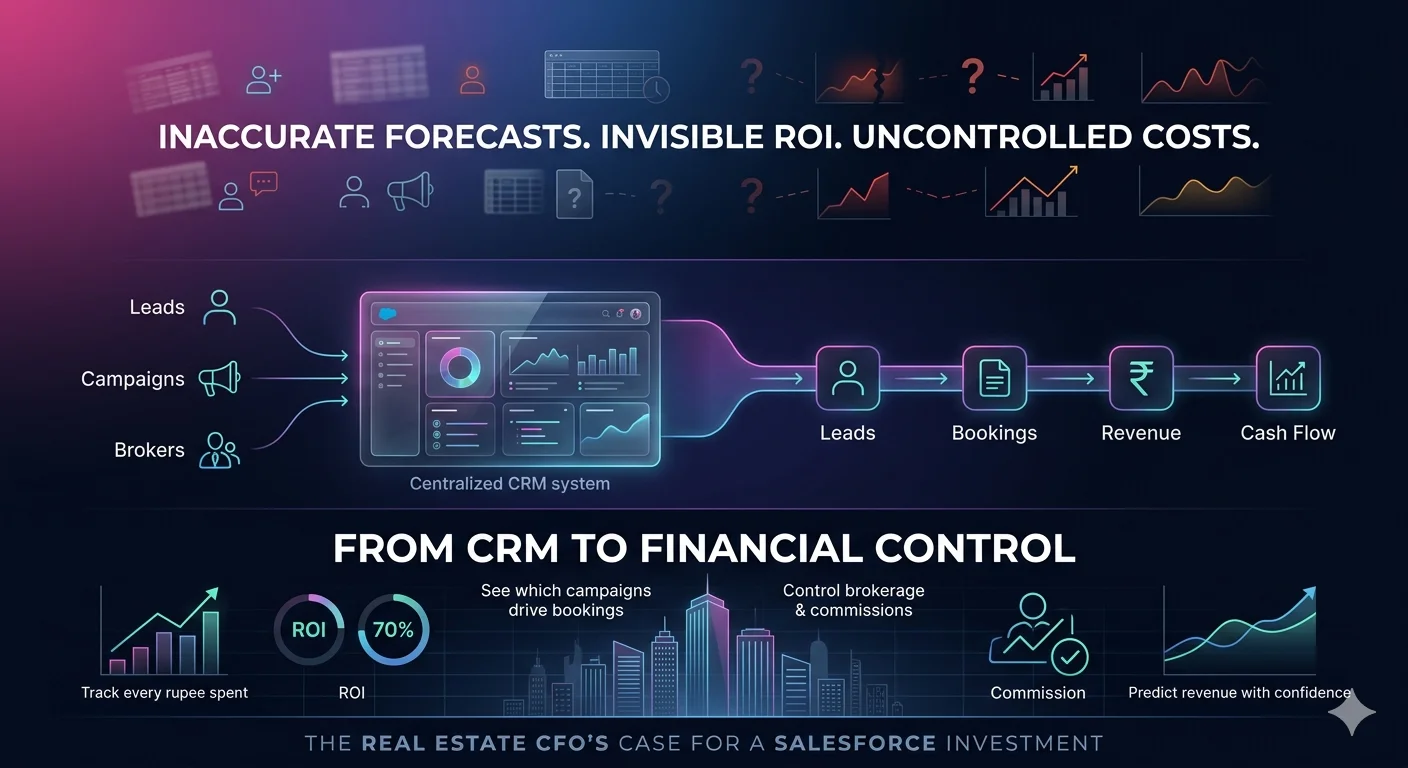
When CRM is implemented correctly, it is not a cost center. It is a financial control system.
Revenue Visibility Is a Finance Problem
The single biggest challenge for real estate CFOs is forecasting accuracy.
Revenue in real estate is milestone-linked. Collections depend on construction progress, demand letter timelines, customer payment behavior, and financing conditions.
When CRM data is incomplete or unreliable, the finance team cannot build accurate collection projections.
They rely on sales reports that are manually compiled. These reports are optimistic by nature, sales teams report pipeline that includes leads they hope to convert, not just leads they are confident about.
The result: revenue projections miss. Cash flow planning breaks. Working capital decisions are made on wrong assumptions.
A domain-led Salesforce implementation connects booking data directly to milestone-based payment schedules, creating real-time collection forecasting that CFOs can rely on.
Lead Cost and Campaign ROI
Real estate developers spend significant sums on digital marketing, Meta, Google, property portals, and outdoor.
But in most organizations, the link between marketing spend and booking revenue is invisible.
A lead comes in. It gets assigned. It progresses or drops. Nobody tracks which campaign source ultimately converted into a booking.
This makes marketing budget allocation impossible to optimize.
With proper attribution modeling built into Salesforce, the CFO can see clearly: which channels generate the highest revenue per rupee invested. Which campaigns produce leads that convert. Which budgets should increase and which should shrink.
This is not a marketing insight. It is a financial one.
Brokerage and Commission Discipline
Channel partner commission management is another area of significant financial risk.
In most organizations, brokerage payouts are processed manually, based on emails, spreadsheets, and informal confirmations.
This creates disputes. It creates delays. And it creates overpayments.
A Salesforce implementation with a structured channel partner module creates a full audit trail: lead source, booking linkage, commission slab, approval workflow, and payout tracking.
For a developer doing significant channel-driven volume, this alone can save meaningful sums annually.
The CFO's Strategic Case
A well-implemented Salesforce system is not an IT expense.
It is a financial infrastructure investment.
One that improves collection forecasting, reduces lead cost per booking, controls commission leakage, and protects margin.
The CFO who champions this investment is not approving a software purchase.
They are building the financial nervous system of the organization.